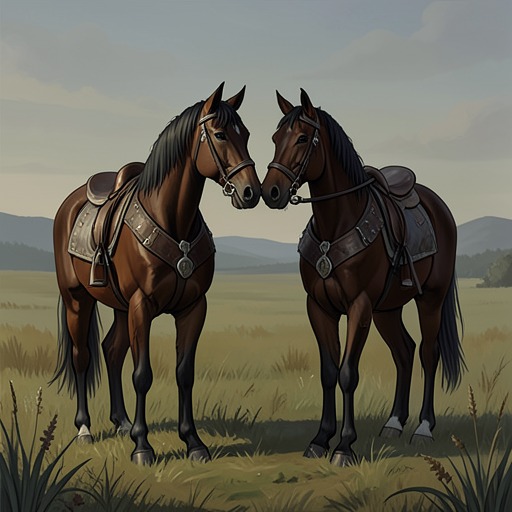
Black Beauty and Ginger’s relationship
Black BeautyBlack Beauty and Ginger’s relationship comes into sharp focus in their unexpected reunion at a London cab stand. Ginger recognizes her old companion, and Black Beauty moves closer so they can speak privately. Their brief encounter reconnects two horses who know one another, but it also exposes how differently their lives have turned out: Black Beauty is comparatively well cared for, while Ginger has been reduced by repeated sales and unremitting work. The meeting makes friendship both a source of comfort and a painful measure of what each has lost or retained.
Recognition and Reunion
One day, while Black Beauty’s cab and others wait outside a park where music is playing, a shabby cab draws up beside them. Its chestnut mare is visibly worn and unsteady. Black Beauty has been eating hay; a little of it blows toward her, and she stretches her neck to pick it up. As he tries to place her, she looks directly at him and recognizes him as Black Beauty. The recognition is immediate even though her appearance has changed so much that he needs a moment to identify her.
The scene is quiet and incidental: the drivers are standing some distance away, and Black Beauty sidles a step or two toward Ginger to make room for a private conversation. That small movement is the reunion’s first answer to Ginger’s recognition. He cannot alter what has happened to her, but he can come near and listen. Their exchange does not restore their former circumstances; instead, it gives Ginger a chance to tell a familiar friend what her present life has become.
Two Diverging Lives
Ginger’s account traces a downward course after her time at Earlshall Park. After a year away, she was judged fit to work again and sold to a gentleman. For a while she managed, but a longer gallop brought back her old difficulty. Rest and treatment were followed by another sale, and she changed hands several times, each time passing lower in the trade. By the time she meets Black Beauty, she has been bought by a man who keeps and hires out cabs and horses.
Her account explains how this system turns her condition into a reason for harsher use. Once her weakness became known, she was assigned to low-grade cabs and treated as an animal whose purchase price had to be recovered through work. The man hiring her also had to earn back what he paid the owner, so the pressure passed down to Ginger. She describes a routine that continues through the week without a Sunday rest. The friendship between the two horses therefore bears witness not just to separation, but to the economic chain that subjects Ginger to work despite her declining capacity.
Their circumstances at the meeting sharpen the contrast. Black Beauty is working in a cab, but he is able to approach Ginger and recognize the state she is in; she, by contrast, has little freedom to leave the work imposed on her. She recalls that she once resisted ill-treatment, but now believes that resistance cannot prevail against cruel people with greater power. Her words convey exhaustion and diminished hope, not a change in the friendship: she tells Black Beauty that he is the only friend she has had.
Friendship in a Moment of Helplessness
Black Beauty is deeply troubled by Ginger’s story. He raises his nose to hers, an act of closeness that expresses what he cannot put into words or remedy. Ginger seems glad to see him. Their reunion offers recognition and companionship, but neither can undo the conditions that have brought them together in such unequal states. Black Beauty’s presence comforts her briefly; it cannot release her from the cab or the demands of those who control her work.
The encounter ends abruptly when Ginger’s driver comes over, tugs at her mouth, backs her out of the line, and drives away. The separation is not a mutual farewell or a choice by either horse. The conversation ends because the working arrangement asserts itself again: Ginger is taken from the friend who has listened to her and returned to the cab’s demands. Black Beauty is left sad, with no opportunity to follow or help her.
An Uncertain Final Separation
A short time later, a cart carrying a dead horse passes the cab stand. Black Beauty notices that the horse is chestnut, has a long, thin neck, and bears a white streak down the forehead. He believes it may be Ginger, but the identification is never confirmed. He hopes it is her because death would mean that her suffering has ended; the hope is also an expression of how bleak her account of working life has made the prospect of survival seem.
The uncertainty matters to their relationship. Black Beauty does not learn what became of Ginger, and the narrative does not turn his suspicion into a confirmed reunion with her in death. Instead, the possibility leaves their last known meeting as a farewell without certainty. Ginger’s wish to escape her misery and Black Beauty’s inability to comfort her are set against the unresolved sight of the cart, making his memory of her more painful without settling her fate.
Narrative Significance
Because the story is presented as Black Beauty’s autobiography, the reunion is reported through the horse who recognizes Ginger, listens to her history, and responds to her distress. Her circumstances reach the reader through both observable changes and her own account of repeated sales and daily work. Their bond gives those facts a personal shape: Ginger is not simply another worn-out cab horse to Black Beauty, but an old companion who recognizes him and calls him her sole friend.
The episode also contrasts Ginger’s precarious existence with Black Beauty’s eventual security. At the end of his story, he lives in a happy home, has pleasant work, is promised that he will never be sold, and imagines himself among old friends at Birtwick Park. Ginger’s fate, by contrast, remains uncertain after their brief meeting. Their relationship thus joins companionship to the book’s concern with humane treatment: recognition and sympathy matter, but the scene also shows how little comfort a friendship can provide when those with control over a working animal refuse to change its conditions.